


Precision agriculture is a modern farming approach that utilizes technology and data-driven insights to monitor field variability and help farmers make more informed decisions.
Precision agriculture has evolved in recent decades alongside advancements in GPS technology and farm automation. Today, precision agriculture is a highly connected system of tools and analytics that help farmers improve efficiency, productivity, and sustainability on the farm.
Key Takeaways
- Precision agriculture is an integrated farming approach that leverages technology, equipment, and data to make smarter decisions for any type of farm.
- Precision agriculture works by first collecting field and equipment data, transmitting information to connected platforms, and then providing detailed results to farmers.
- Examples of precision agriculture technologies include guidance systems, variable rate technology (VRT), yield monitoring systems, and crop sensors.
- John Deere precision agriculture solutions integrate technologies for data management, equipment guidance, and variable rate application to improve farming operations.
What Is Precision Agriculture?
Precision agriculture is used to connect people, equipment, and technology in order to improve overall efficiency on the farm. With precision agriculture, farmers can gain access and control of data so they can streamline and improve processes year-round.
Precision agriculture is built on a combination of technologies such as GPS guidance, sensors, and remote data collection to support activities such as planting, spraying, and harvesting with greater accuracy and control.
Instead of viewing the whole field as a single unit, precision agriculture allows farmers to divide fields into management zones and make decisions based on the specific needs of each area.
This targeted approach helps improve productivity and sustainability by ensuring each area of a farm has exactly what it requires.
Where Is Precision Agriculture Used?
Precision agriculture is used across farms worldwide, from small family farms to large-scale commercial operations. It can be used anywhere a farmer wants to improve efficiency and make more data-driven decisions about their farm.
It is most commonly used in row crop production, where larger fields can benefit from technologies that improve planting accuracy. It is also widely used when growing specialty crops, where precise application of crop protection products is important for maintaining crop health.
How Does Precision Agriculture Work?
Precision agriculture works by combining technology and data in order to collect and analyze information about field conditions and equipment performance.
To effectively utilize precision agriculture, the process typically involves 4 key steps:
1. Data Collection
Precision agriculture begins with collecting field and equipment data such as soil conditions, crop health, and machine activity. The data is gathered using GPS receivers, sensors, and connected equipment that can track real-time conditions throughout a field. The receiver plays a critical role in this process by receiving satellite signals and providing machine data and location information to farmers.
2. Data Transmission
Once the data has been collected, it is then transmitted from machines, displays, and sensors to farm management systems, either in real time or through periodic synchronization. This allows farmers to stay updated on their field and equipment performance from one centralized platform. The data is then processed to diagnose patterns and identify areas of improvement.
3. Decision Making
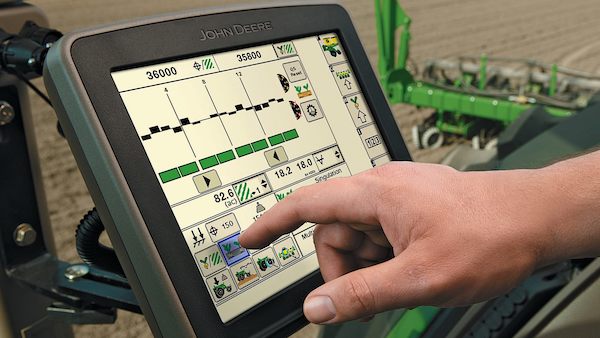
Farm management systems and in-cab displays provide farmers with detailed data that allows them to make decisions for their farm. These displays give insight into a machine’s location, field conditions, and performance. Based on this information, farmers can adjust their settings for planting, spraying, or harvesting accordingly.
4. Continuous Monitoring
After farmers make these application decisions, their systems will continue to monitor performance. Farmers can then compare results over time and make adjustments as needed in order to improve efficiency and productivity on their farm. This ongoing feedback allows for continuous improvement of farming operations and supports long-term success.
What Are Examples of Precision Agriculture Technologies?
Precision agriculture technologies help farmers collect and analyze data to improve productivity across farming operations. These technologies work in tandem with farming equipment and play an important role in helping farmers reduce waste and optimize inputs.
Below are 6 examples of precision agriculture technologies used in modern agriculture practices:
1. Guidance Systems
Guidance systems use GPS and satellite technology to help farmers create consistent paths across a field. These systems improve precision and reduce overlap when planting, spraying, or harvesting crop rows. Many guidance systems can use automated steering so that tractors can follow these consistent routes.
2. Variable Rate Technology (VRT)
Variable rate technology allows farmers to adjust the application of inputs such as seeds, fertilizers, and crop protection products based on field variability. Instead of applying uniform inputs, VRT uses the data collected from the field to ensure these inputs are placed in the correct location.
3. Yield Monitoring Systems
Yield monitoring systems record crop data during harvest to help farmers understand their field performance. These systems can identify variations across different areas of a field and help farmers make smarter input decisions.
4. Automatic Section Control
Automatic section control helps reduce input overlap by automatically turning equipment sections on or off as machines move around a field. This helps reduce waste as it ensures inputs are only applied where needed. As a result, this technology helps lower operating costs and reduce unnecessary waste.
5. Crop Sensors
Crop and field sensors collect real-time information about crop vigor, biomass, soil conditions, and field variability. This data can help farmers monitor differences across their farm and support more precise applications.
6. Remote Data Collection
Remote data collection allows farmers to gather information without needing to be physically present in a field. Connected systems and cloud-based platforms will monitor and transmit the data remotely to support faster decision-making.
What Equipment Is Used in Precision Agriculture?
A range of equipment types is needed in order to implement precision agriculture technologies across farming operations. When integrated with systems such as GPS guidance, sensors, and other automated systems, these machines can help farmers better manage field variability.
Tractors
Tractors are incredibly versatile and serve as the primary equipment for precision agriculture practices. When equipped with precision agriculture technology, tractors can support GPS guidance, data collection, and automation to improve field activities.
Planting and Seeding Equipment
Planters and seeding equipment use precision agriculture technology to ensure correct seed placement across a field. These systems can adjust spacing and the rates of seeding based on data to improve crop health and reduce input waste.
Sprayers and Application Equipment
Sprayers and application equipment are used to apply crop protection products and other inputs across a field. With the added precision agriculture technology, the machines can adjust application rates accordingly to help reduce overlap and minimize waste.
Harvesting Equipment
Harvesting equipment can be equipped with precision agriculture technology in order to collect crops while also gathering valuable field data. Yield monitoring systems can track productivity across the field to improve future planting and crop management strategies.
Tillage and Soil Preparation Equipment
Tillage and soil preparation equipment help create consistent field conditions by breaking up soil and preparing seedbeds. When integrated with precision agriculture technology, these machines can maintain consistent depth and reduce unnecessary passes across the field.
What Are the Benefits of Precision Agriculture?
Precision agriculture helps farmers integrate their equipment with data to perform daily tasks more effectively. By improving accuracy across operations and gaining insight into field conditions, precision agriculture technology can help increase efficiency, reduce costs, improve sustainability, and support improved crop productivity.
Increased Efficiency and Productivity
Precision agriculture helps farmers increase efficiency by enabling more accurate, precise actions across different farming tasks. Technologies such as GPS guidance systems, automatic section control, and crop sensors help reduce overlap, minimize missed areas, and optimize machine performance. As a result, farmers can reduce fuel usage and improve productivity across projects.
Reduced Input Costs
Precision agriculture helps reduce input costs by ensuring they are applied precisely. Instead of uniform application across a field, inputs are changed based on field variability. This approach helps minimize waste and, therefore, reduce overall operating expenses.
Improved Sustainability Efforts
Precision agriculture supports more sustainable farming practices by reducing input use and improving resource efficiency. By applying inputs only where needed, farmers can conserve these resources, leading to reduced runoff and less of an environmental impact. These sustainable practices also support soil health and land management.
Greater Crop Yields
Precision agriculture can help improve yield potential by enabling more precise and consistent input application. As a result, farmers can create the most optimal growing conditions across different field zones, leading to improved crop health and improved yield potential over time.
What Are Examples of John Deere Precision Agriculture Solutions?
John Deere offers a variety of precision agriculture solutions to help farmers collect and analyze data on their farms. These solutions include a wide range of farming technologies, including equipment guidance, variable rate technology (VRT), and crop sensors.
Many of these solutions work together through core connected platforms such as JDLink™, which provides machine connectivity and equipment data, and the John Deere Operations Center, a farm management platform designed to help farmers access, analyze, and use their operational data.
Below are 5 different types of precision agriculture solutions, and how they can be helpful for your farm.
1. Data Management Solutions
The data explosion of the past few decades has made its way into farming. Efficiency has also blossomed as a result. Without data management solutions, it can be simple to lose time or miss out on data-informed decisions.
Below are the data management solutions offered by John Deere:
- Mobile Data Transfer
- APEX™
- Mobile Farm Manager
- Connect Mobile
- Harvest Mobile
- Yield Documentation, Specialty Crops
- John Deere HarvestLab™
- Harvest Identification, Cotton
2. Remote Management Solutions
If you are away from your farm, it is important that your processes keep moving. With Deere’s remote management solutions, you are able to send work orders to your equipment, as well as access/analyze reports, and track equipment/usage via a wireless connection.
Below are the remote management tools offered by John Deere:
- Remote Display Access
- Connected Support™
- Equipment Mobile
- Work Planner
- AutoSetup™
- Service ADVISOR™ Remote
- AgLogic™
3. Equipment Guidance
Missing areas in a field or going over certain terrains more than once can be costly in terms of time and money. Additionally, seeds and chemicals needed to maintain a large-scale operation are not inexpensive. It is important they are placed with precision, and solely in the spots where they are needed most. Guidance solutions such as AutoTrac™ help farmers maintain machine paths and improve operational efficiency.
Below are the equipment guidance solutions offered by John Deere:
- StarFire™ 6000
- StarFire™ 7500
- RTK Radio 450
- RTK Radio 900
- Mobile RTK
- AutoTrac™
- AutoTrac™ Controller
- AutoTrac™ Universal
- AutoTrac™ RowSense™ – Combine
- AutoTrac™ RowSense™ – Sprayer
- AutoTrac™ Vision
- AutoPath™
- 4640 Display
- G5 Display
- GreenStar™ 3 2630
- GreenStar™ 2 1800
- Gen 4 Monitor
- Gen 4 CommandCenter
- Machine Sync
- Active Fill Control
- Active Implement Guidance
- iTEC™ Pro
4. Field and Water Management
Natural resources, such as water or soil, are precious and, therefore, very important to conserve as much as possible. Automating your watering and soil process can be an important step in doing so, helping to reduce waste and save on labor costs. Field and water management solutions can help farmers conserve natural resources and support more sustainable farming practices.
Below are the field and water management solutions offered by John Deere:
- John Deere Field Connect™
- John Deere Mobile Weather
- Surface Water Pro™ Plus
- iGrade™
5. Variable Rate Application
Variable rate application is a precision agriculture technology that allows farmers to apply seed or crop protection products at different rates. Instead of applying the same amount of inputs on a field, variable rate systems use field data to deliver the right amount.
Below are the variable rate application solutions offered by John Deere:
- John Deere Section Control
- John Deere Rate Controller 2000
- Raven AccuFlow™ Vortex
- Raven Sidekick Pro™
- John Deere ExactApply™
Learn More About Precision Agriculture Technology and Solutions
Precision agriculture is transforming modern farming practices by helping farmers improve efficiency and make more informed decisions for their farms. From GPS guidance to variable rate technology, these systems are continuing to evolve. John Deere offers a variety of solutions that can help you with everything from data management to field and water management.
To learn more about precision agriculture technology and equipment, contact your local John Deere dealer.
Precision Agriculture FAQs
How does precision agriculture improve sustainability?
Precision agriculture improves sustainability by helping farmers make optimized decisions. Instead of applying fertilizer or crop protection products uniformly, farmers can use data-driven insights to reduce unnecessary use. This approach helps reduce runoff, minimize waste, and support long-term soil and water management practices.
What is the difference between precision agriculture and smart farming?
Precision agriculture focuses specifically on using data and technology to improve farming practices, including planting, spraying, and harvesting. Smart farming is a broader concept that includes precision agriculture but also other connected systems that can integrate the entire farm operation.
How can farmers get started with precision agriculture?
Farmers can get started with precision agriculture by gradually adopting tools and technologies for their fleet. Common first precision agriculture technologies include GPS guidance systems, yield monitoring equipment, and variable rate technology (VRT). These systems can be added to existing equipment to make it easier to start the practice of precision agriculture.
What is the difference between precision agriculture and conventional agriculture?
The main difference between precision agriculture and conventional agriculture is how data is used to manage operations. Conventional agriculture practices typically utilize consistent processes of applying the same inputs across a field. Precision agriculture, on the other hand, uses integrated data and technology to account for differences in field conditions and therefore make more targeted decisions.
Can precision agriculture be used with older equipment?
Yes, precision agriculture can often be used with older equipment. Many guidance systems, sensors, and monitoring tools can be installed on existing equipment to provide the same insights without needing to make additional investments.